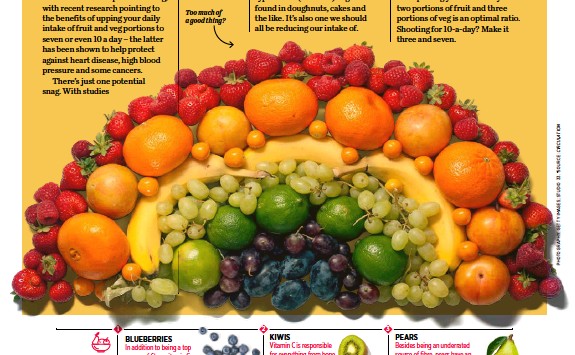
As new research links too much fructose with metabolic disorders, should you cap your fruit intake?
Read : Health and Wellness Blog India
With, perhaps, the exception of your nightly eight hours, there are few health targets as etched into our collective consciousness as the five-a-day. And yet, the number keeps on climbing, with recent research pointing to the benefits of upping your daily intake of fruit and veg portions to seven or even 10 a day – the latter has been shown to help protect against heart disease, high blood pressure and some cancers.
There’s just one potential snag. With studies linking high consumption of fructose – a natural sugar found in fruit – with metabolic disorders, can you have too much of a good thing?
A quick glance at the research would suggest so. There’s a great deal of evidence to show that high intake of fructose is associated with an imbalance in cholesterol levels, high blood pressure and fatty liver disease, along with other metabolic disorders, such as heart disease.
But dig into how those studies were conducted and you begin to see why fruit is actually innocent.
First, such studies were observational, meaning we can’t conclude with any certainty that the fructose was responsible. What’s more, they primarily investigated the effects of high-fructose corn syrup, which is a concentrated form of fructose and a common type of free (or added) sugar found in doughnuts, cakes and the like. It’s also one we should all be reducing our intake of.
Any advice to limit sugar intake doesn’t apply to fresh fruit, though. That’s because the fructose found in fruit is released into your bloodstream much slower and doesn’t spike your blood sugar like a biscuit does. That fruit is also packed with vitamins, minerals and antioxidants only makes the case for eating more of it stronger.
But it’s advice that comes with a caveat. Dried fruit is a more concentrated source of fructose, so the recommended portion size is smaller (30g rather than 80g). And the way that smoothies and fruit juice are processed releases sugars from the cells, making them ‘free’, which increases their sugar content. It’s why you should stick to 150ml of fruit juice or smoothie a day.
Still struggling to find the right balance? A 2021 study* concluded that splitting your five-a-day into two portions of fruit and three portions of veg is an optimal ratio. Shooting for 10-a-day? Make it three and seven.
 Healthy Living & Life Style Blog